Participle Phrases
分詞片語與構句應用
📚 Crescent Education 文法核心概念 Mastery Checklist
本單元全面解析分詞片語的核心結構:代替形容詞子句 (修飾名詞)、表達動作的先後與同時發生,以及說明原因與狀態。掌握 -ing (主動) 與 -ed (被動) 的精準用法,寫出高階英文句型。
📝 Participle Phrases 練習 (Exercises)
🧱 Foundation
(Reduced Relative Clauses)
S3 Participle Phrases (一)
本卷針對 Category 1:縮減形容詞子句 (修飾名詞) 的基礎轉換練習(Reduced Relative Clauses)
🎯 Skill Builder 1
(Time & Sequence)
S3 Participle Phrases (二)
本卷針對 Category 2:表達動作發生的時間與順序(Time & Sequence)
📖 分詞片語 圖解筆記 (Notes & Strategies)
三大核心分詞技巧 🚀
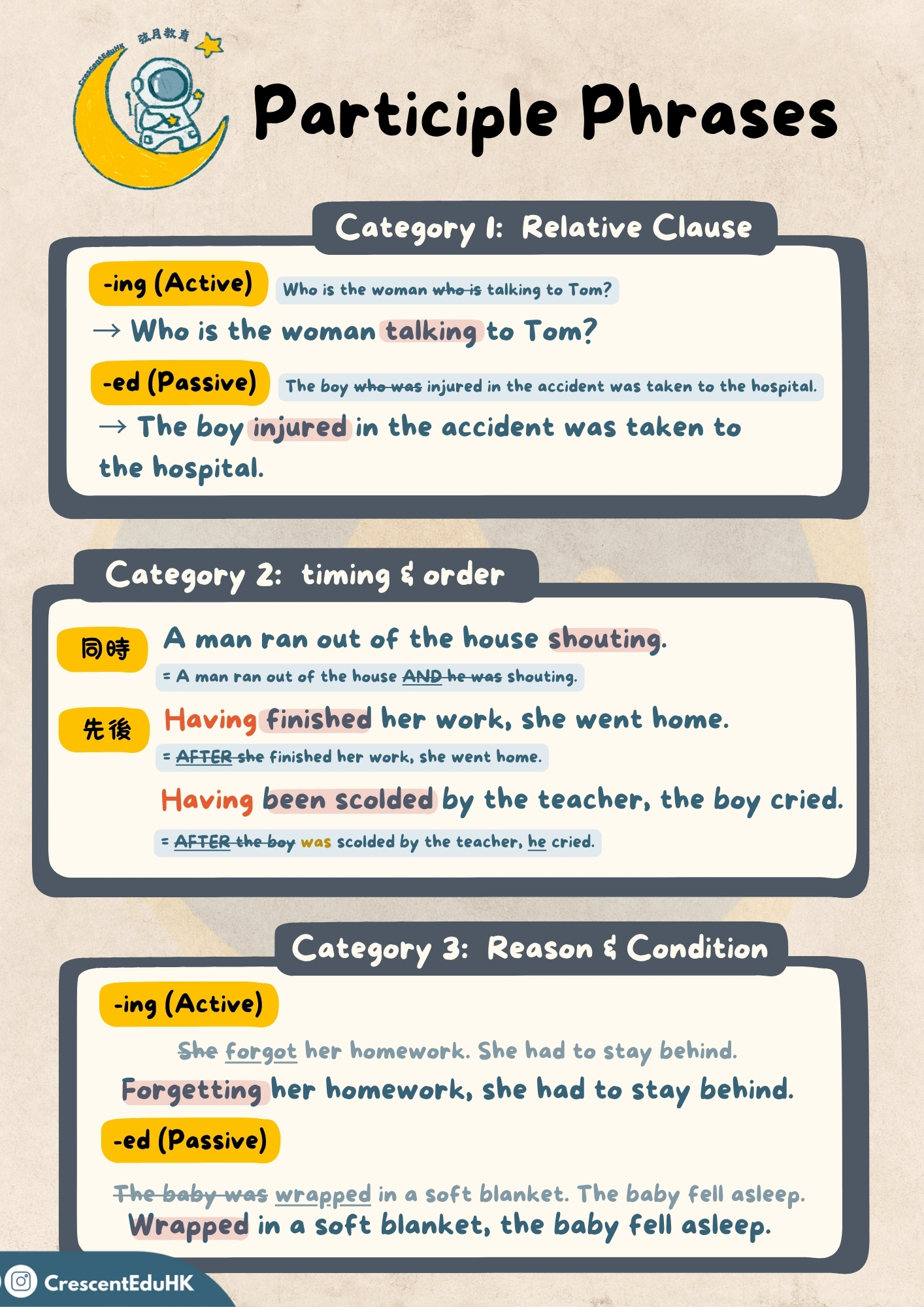
👤 1. 縮減形容詞子句 (修飾名詞)
分詞可以直接放在名詞後方進行修飾,作用等同於省略了 “who/which is…” 的關係子句。
A. -ing 結尾(主動進行 / Active)
表示名詞「正在進行」或「主動執行」某動作:
Original (原句)
Who is the woman who is talking to Tom?
省略 who is ➔
Participle Clause (分詞片語)
Who is the woman who is talking to Tom?
B. -ed 結尾(被動狀態 / Passive)
表示名詞「被…」或「處於…狀態」:
Original (原句)
The boy who was injured in the accident was taken to hospital.
省略 who was ➔
Participle Clause (分詞片語)
The boy who was injured in the accident was taken to hospital.
⏳ 2. 表達動作發生的時間與順序 (Time & Sequence)
可以利用分詞片語來表達兩個動作是「同時發生」或「先後發生」。
⚠️ 核心法則:使用分詞片語合併句子時,兩個動作必須是「同一個主角(主語)」!
A. 兩個動作同時發生 (Simultaneous Actions)
使用 -ing (或前面加上 while/when):
• A man ran out of the house shouting.
(= he ran out AND he was shouting)
• Joe hurt his knee playing football.
(= while he was playing)
(= he ran out AND he was shouting)
• Joe hurt his knee playing football.
(= while he was playing)
B. 兩個動作先後發生 (Sequential Actions)
先完成的動作使用 Having + V.P.P (done),或用 After + -ing:
💡 Having finished her work, she went home.
(= AFTER she finished her work, she went home)
*注意:遇到這類句型,分詞片語後方必須加上逗號 (,)。
*注意:遇到這類句型,分詞片語後方必須加上逗號 (,)。
🧩 3. 表達原因與狀態 (Reason & Condition)
可以使用 -ing 來解釋某事或說明做某事的原因,也可以直接用 -ed 開頭來表達主詞所處的狀態。
📍 狀態表達 (Past Participle 開頭):
• Wrapped in a soft blanket, the baby fell asleep.
(= After he was wrapped in a soft blanket…)
📍 原因表達 (Past Participle 開頭):
• Dressed in a suit and tie, Thomas looked very smart.
(= Thomas looked very smart because he was dressed in a suit and tie.)
• Wrapped in a soft blanket, the baby fell asleep.
(= After he was wrapped in a soft blanket…)
📍 原因表達 (Past Participle 開頭):
• Dressed in a suit and tie, Thomas looked very smart.
(= Thomas looked very smart because he was dressed in a suit and tie.)
🏆 考試實戰題 (Exam Examples)
結合題目卷,表達「原因與狀態」的分詞合併:
實戰題一:主動原因 (-ing)
📝 題目:
She forgot her homework. She had to stay after class to finish it.
💡 思考步驟:
1. 檢查主角:兩句的主角都是 “She”(符合同主角法則)。
2. 判斷關係:忘記帶功課是主動發生的「原因」。
3. 轉換分詞:將動詞 “forgot” 改為主動分詞 “Forgetting”。
✅ 答案:
Forgetting her homework, she had to stay after class to finish it.
📝 題目:
She forgot her homework. She had to stay after class to finish it.
💡 思考步驟:
1. 檢查主角:兩句的主角都是 “She”(符合同主角法則)。
2. 判斷關係:忘記帶功課是主動發生的「原因」。
3. 轉換分詞:將動詞 “forgot” 改為主動分詞 “Forgetting”。
✅ 答案:
Forgetting her homework, she had to stay after class to finish it.
實戰題二:被動狀態 (-ed)
📝 題目:
The book was written in the 1800s. It is still read by many people today.
💡 思考步驟:
1. 檢查主角:兩句的主角都是 “The book”(第二句的 It 代指 The book)。
2. 判斷關係:書是「被寫」出來的,帶有被動狀態。
3. 轉換分詞:省略主詞與 be 動詞 (was),直接保留過去分詞 “Written” 放句首修飾。
✅ 答案:
Written in the 1800s, the book is still read by many people today.
📝 題目:
The book was written in the 1800s. It is still read by many people today.
💡 思考步驟:
1. 檢查主角:兩句的主角都是 “The book”(第二句的 It 代指 The book)。
2. 判斷關係:書是「被寫」出來的,帶有被動狀態。
3. 轉換分詞:省略主詞與 be 動詞 (was),直接保留過去分詞 “Written” 放句首修飾。
✅ 答案:
Written in the 1800s, the book is still read by many people today.
全方位濃縮補習課程
熱門皇牌・獨家輸入輸出記憶法
‘A great classroom comes from the heart.’
由本地老師教授的互動課程,深深明白良好的環境能推動學生主動學習,所以透過小組溝通和練習,見證多位由不願上課轉變為喜愛學習的學生。
弦月教育補習社進步實例
– 適合不想死記硬背的學生 –
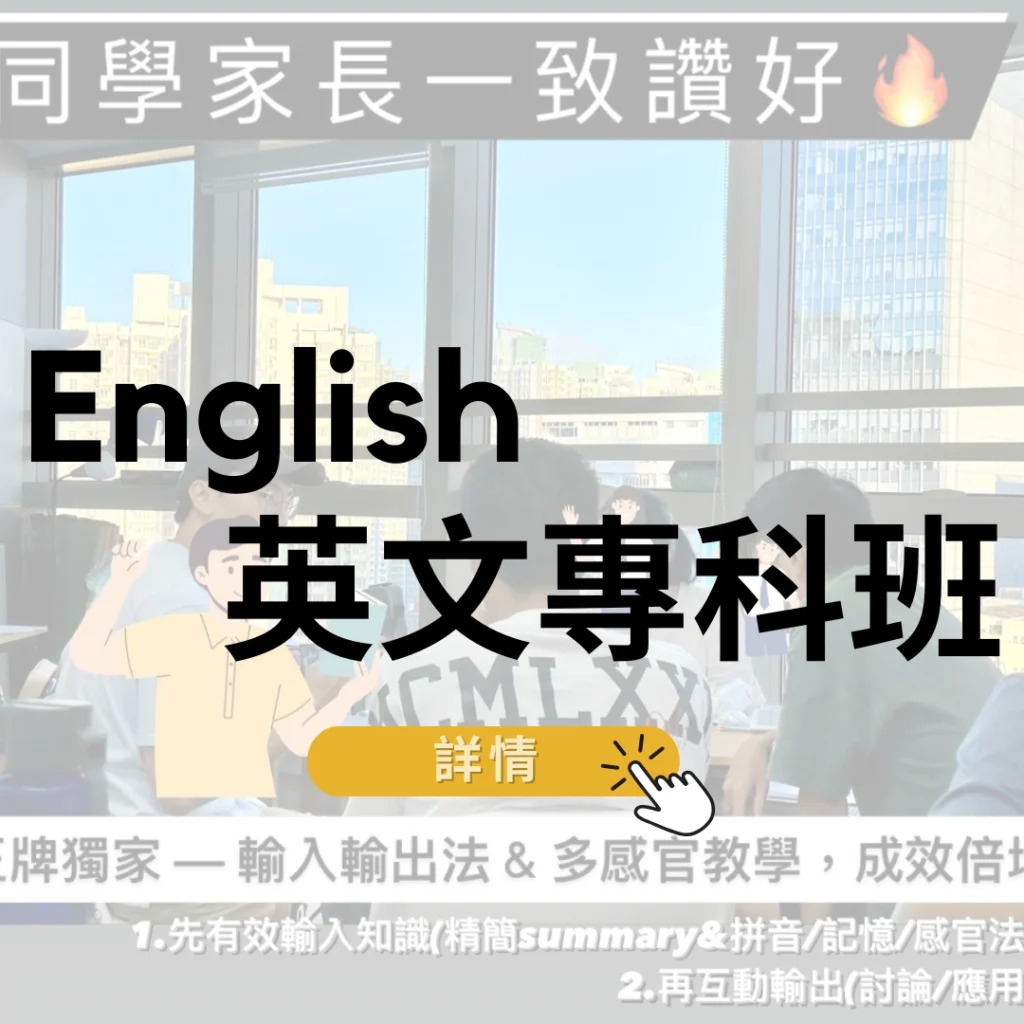
王牌獨家👑
專業導師以輸入輸出法 & 多感官法作教學,成效倍增
落地玻璃☁️
光線充足的舒適互動讓學生打從心底喜愛學習